
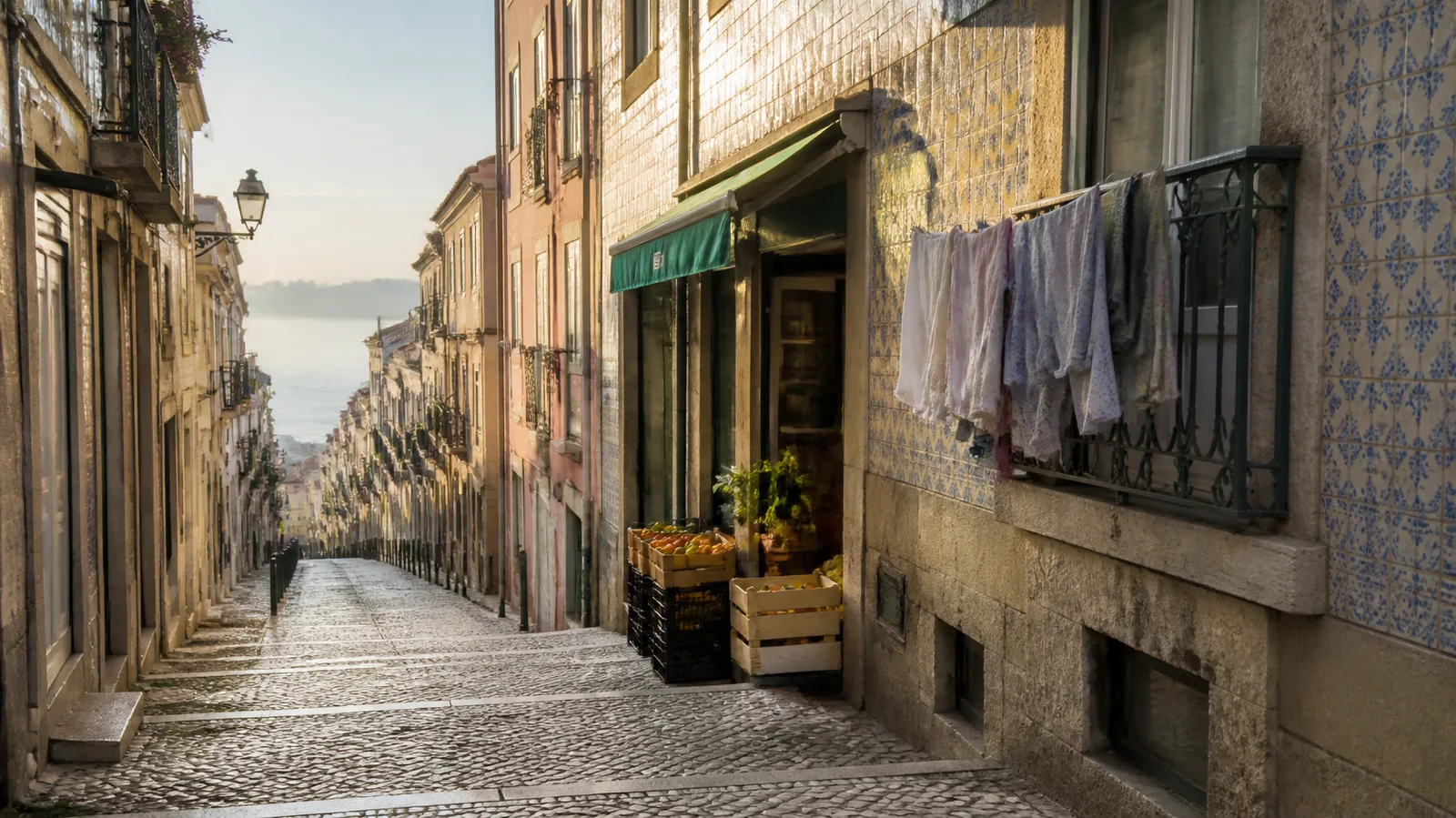
Illustrative image of a street in Madragoa, Lisbon.
By Rafaela Martins
Despite the common belief that living in Madragoa means living inside a postcard, anyone researching the neighbourhood mostly finds just that: holiday flats, places to eat, afternoon walking routes. Almost nothing answers what someone thinking of moving here actually needs: where to buy fruit, how often the tram comes, what it takes to walk up to Estrela with a bag in each hand.
So I did a different exercise. I opened Google Maps and measured, from number 24 of Rua do Machadinho, what an ordinary week requires. These are estimated walking times, checked on 6 November 2026, that anyone can repeat. The exact street changes the numbers, but the logic holds.
Let us take it step by step.
Where exactly is Madragoa?
Madragoa is not a parish. It is a neighbourhood inside the parish of Estrela, created in 2012 by merging Lapa, Prazeres and Santos-o-Velho. It sits on the slope between Lapa and Santos: uphill is Estrela, downhill is Avenida 24 de Julho, the railway line and, beyond them, the river.
This geography explains almost everything that follows. In Madragoa, the question is never just how far something is. It is also whether it is uphill or downhill.
Who made this neighbourhood?
Two memories live side by side here. The first is the convents: at one point there were three in a small area, and Rua das Madres (Mothers’ Street) keeps that memory in its name. The second is the fishing families who came from Alfama and the varinas, the fishwives who gave the neighbourhood its lively reputation.
The Convento das Bernardas brings the two together. King John IV founded it in 1653, the 1755 earthquake almost destroyed it and, after the nuns left, the building gradually filled with people. In 1990 more than a hundred families lived there, in an overcrowded, run-down building. Lisbon City Council bought it at the end of 1998 and restored it between 1999 and 2001. The families were given the choice of returning or being compensated, and 34 stayed. The Puppet Museum (Museu da Marioneta) moved in in November 2001.
This is not a guidebook detail. It is the best description of Madragoa I know: a convent that became a home again.
Living in Madragoa: what is less than ten minutes away on foot?
Here is what an ordinary week requires, counting from the same door:
- 4 minutes (270 m): Puppet Museum, in the Convento das Bernardas.
- 4 minutes (300 m): Chafariz da Esperança fountain.
- 5 minutes (350 m): the Mercado D’ Santos grocery, on Rua de Santos-o-Velho, and the Santos 82 supermarket, on Avenida D. Carlos I.
- 5 minutes (400 m): Farmácia Conde Barão pharmacy.
- 5 minutes: tram 25 stop, on Rua de São João da Mata.
- 8 minutes (600 m): Jardim de Santos garden.
- 10 minutes (700 m): Santos railway station.
The list is short on purpose. It does not show abundance, it shows scale. Fruit, medicine and the garden are all within walking distance, without taking the car. A little further, 13 minutes away, is Rua das Janelas Verdes, with the National Museum of Ancient Art.
And there are tables with history. A Varina da Madragoa, opened in 1967 on Rua das Madres, reopened at the end of May 2026 under new management. A neighbourhood is also measured by what reopens.
How do you get to work from here?
Today there are three routes. Tram 25 links to Praça da Figueira: on the morning I checked, Google Maps showed 22 minutes in total, with trams every 15 minutes. The Cascais line train stops at Santos. And Cais do Sodré is 18 minutes on foot, along Avenida 24 de Julho.
What neighbourhood guides do not yet mention is the metro. The Circular Line will bring Estrela and Santos stations, and Santos will run parallel to Avenida D. Carlos I. It will have two entrances: the main one by Largo da Esperança and a second one, lift only, facing Madragoa.
The metro is coming. In June, Lisbon Metro was already talking about finishing works at both stations, and the official forecast is the first quarter of 2027. The date has already moved several times, through 2023, 2025 and 2026, and in early November the Government said it was studying a loop line as a complement. So I would not choose a home counting on opening day. But I would choose it knowing the station is on its way.
With the metro also comes the added value that better access usually brings. Studies in Porto and in the south of the Madrid region found a positive effect of being close to a station on house prices. Results vary and none measures Lisbon, so I will not promise percentages. What I can say is this: Madragoa is about to get closer to the rest of the city, and that matters both for those who live here and for the value of the home.
What should you know before buying a home here?
A beautiful neighbourhood does not excuse you from asking questions. These are the four I would ask.
The slope. Jardim da Estrela is 850 metres away: 14 minutes uphill, 12 downhill. Two minutes may seem little, but they say a lot about the gradient, especially with a pushchair or the weekly shopping. And many old buildings have no lift.
The car. In 2019, Time Out summed up Madragoa like this: “There is no parking, and for now there is no metro”. I found no recent data saying otherwise. If you depend on a car, check the rules and availability street by street before deciding.
Schools. The Passos Manuel primary and secondary school is 11 minutes away (800 m). Of the primary schools Google Maps showed me in this search, Padre Abel Varzim and Eng. Ressano Garcia are about 21 minutes away (1.3 km). It is not a complete list, and placement depends on each year’s rules. If you have young children, sort this out before signing.
The river and the night. The river is close, but not on the doorstep: the avenue and the railway line are in between. And Madragoa is also a place to go out for dinner. My suggestion is simple: visit the street on a Tuesday morning and on a Friday night. They are two different neighbourhoods, and you should like both.
What kind of life fits in Madragoa?
The life of a couple who would rather walk and do not mind a climb. Of young people who want to live the city, not just visit it at weekends. Of those happy to trade a garage for a grocery five minutes away.
It also fits those who work from home. For someone at a computer all day, the neighbourhood is the break: fruit, the garden and coffee are all a walk away. The same goes for digital nomads and for people arriving in Lisbon from abroad who want to live in a neighbourhood, not in a gated complex. If you live off your laptop, one piece of advice: before signing, check fibre internet at the exact address.
It is not for everyone, and that is one of the reasons it is worth it.
This is the neighbourhood of Machadinho 24·32: a Pombaline building under restoration, with eight homes from studio to two bedrooms. It has no lift, and I would rather say so now. Anyone who wants to hear about news can leave their details. If you are thinking about a first purchase, I wrote here about mortgages and support in 2026. If you are coming from abroad, start with the article on buying property in Portugal as a non-resident.
Choosing a neighbourhood is choosing a routine. The home matters a lot, but it is the routine you live every day.
Would you like to see Madragoa with me, on foot, at the time of day that matters to you? Write to contato@thereachrealestate.com or on WhatsApp (+351 912 588 145).
By Rafaela Martins
Reference sources
Accessed 6 November 2026. Walking times and distances: Google Maps estimates from Rua do Machadinho, 24.
- Diário de Notícias: 2027 budget, Government considers combining the Circular Line with a loop line (in Portuguese)
- Lisbon Metro: progress of works at Estrela and Santos stations (in Portuguese)
- Lisboa Para Pessoas: images of the future Estrela, Santos and Cais do Sodré stations (in Portuguese)
- Executive Digest: Circular Line delays and costs (in Portuguese)
- RTP/Lusa: Convento das Bernardas, an example of rehousing in Lisbon (in Portuguese)
- Puppet Museum: history of the museum and the convent
- Lisbon Portugal Tourism: Madragoa guide
- Lisboa Secreta: Varina da Madragoa is back
- Time Out Lisboa: the best of Santos and Madragoa (2019) (in Portuguese)
- Wikipedia: Estrela (Lisbon) (in Portuguese)
- CP: Cascais line timetables (in Portuguese)
- University of Porto: the impact of the Porto Metro on property values (dissertation, 2018) (in Portuguese)
- Mejia Dorantes, Paez and Vassallo: effects of Madrid Metro Line 12 on house prices